In Greenland, where melting ice and shifting seasons are part of daily life, climate awareness is not just a subject — it’s a lived reality. Across the country, young people are transforming that reality into action through education, school projects, and youth-led initiatives that combine science, creativity, and community spirit.
Learning to understand a changing Arctic
In recent years, climate education has become a growing priority for Greenlandic schools. Teachers are integrating Arctic ecosystems, biodiversity, and climate change into their lessons, encouraging students to connect global environmental issues with their local surroundings.
A project by the Nordic research centre Nordregio showed how high school students and teachers in Greenland developed new materials for teaching climate change, linking the classroom experience to field observations in their own communities. These efforts help young people see how environmental knowledge can empower them to make informed decisions about their future.
Educational organisations such as ProGreenland also play a supporting role by promoting environmental awareness and non-formal learning. Their activities help schools and local youth groups explore sustainability topics in accessible and creative ways, even in remote Arctic regions.
From classrooms to Arctic expeditions
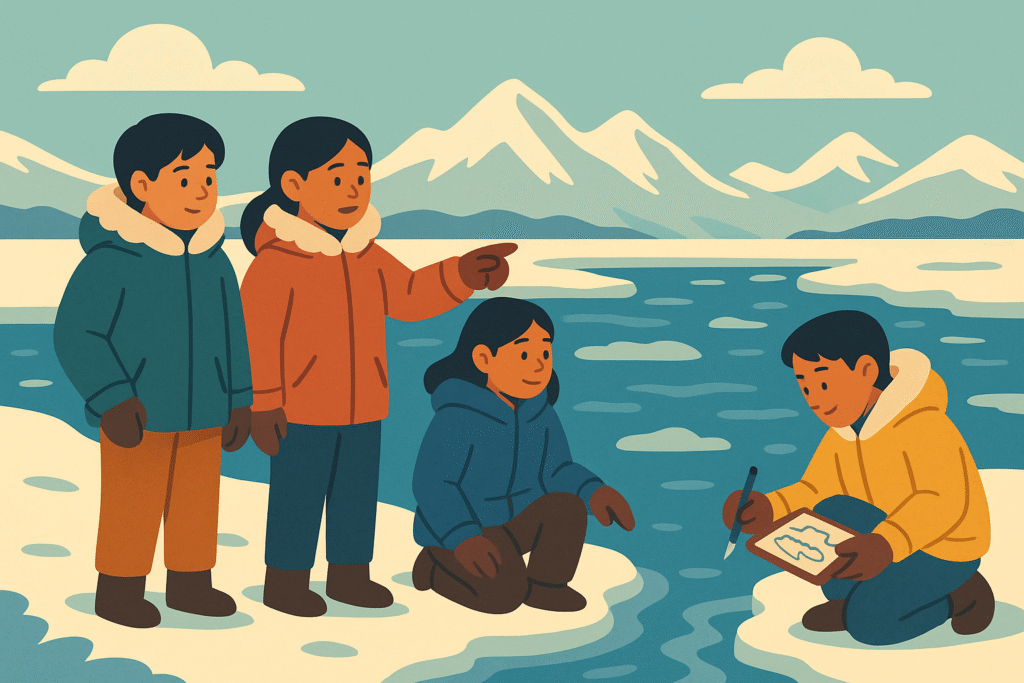
For many Greenlandic students, learning goes beyond textbooks. Initiatives such as the Kalaallit Nunaat to Nunavut Expedition, organised by the Students on Ice Foundation, bring young people from Greenland and Canada together to explore the effects of climate change on Arctic ecosystems. During these expeditions, students observe biodiversity loss, learn from Indigenous knowledge, and reflect on their role as Arctic citizens.
Other exchange programmes and youth collaborations — often supported by Nordic and European educational networks — connect Greenlandic students with peers from across the Arctic. These experiences allow them to share their perspectives on sustainability and build international solidarity among young climate advocates.
Youth voices shaping the conversation
Greenland’s youth are increasingly visible in climate activism and public dialogue. In Nuuk, young people have organised school discussions, community events, and social media campaigns to raise awareness about plastic waste, recycling, and energy use.
Their approach combines local pride with global awareness: protecting Arctic nature while contributing to worldwide climate movements such as Fridays for Future. These actions demonstrate how even small communities can spark conversations that resonate far beyond their borders.
Why it matters
Education is proving to be one of Greenland’s strongest tools for climate action. By empowering students to understand, discuss, and respond to environmental change, schools and youth organisations are building resilience for the future.
In the Arctic, where climate impacts are felt first and most severely, every lesson, project, and youth initiative becomes a step toward a more sustainable tomorrow.
Sources:
Nordregio – Climate Change Teaching in Greenland (2019) — https://nordregioprojects.org/blog/2019/09/30/climate-change-teaching-in-greenland/
SOI Foundation – Kalaallit Nunaat to Nunavut Expedition (2024) — https://soifoundation.org/en/knn2024/
WWF Arctic – Students fighting for climate action — https://www.arcticwwf.org/newsroom/features/students-fighting-for-climate-action/