
A New Hub for Craft Beer and Community
The Braunstein Taphouse is conceived as a visitor centre for the micro-brewery Braunstein and as a communal gathering place for the local neighbourhood. Located on the harbour quay of Køge, the building welcomes the brewery’s more than 15,000 annual visitors while also offering spaces that local residents and associations can use.
Design Strategy & Circular Economy
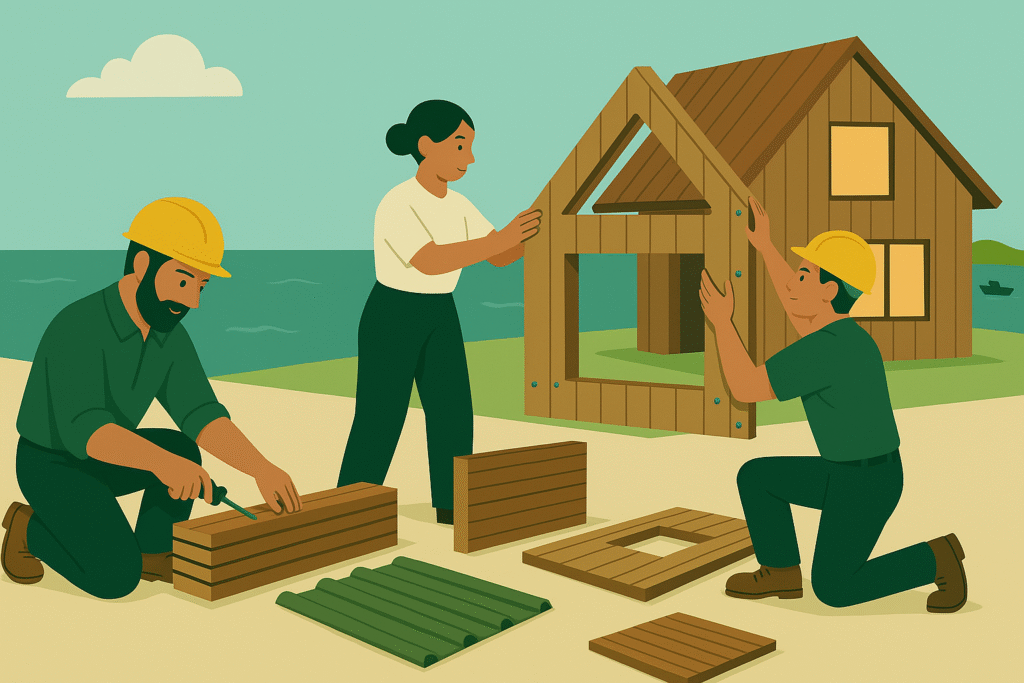
What sets this project apart is its “design for disassembly” approach. The building is constructed so that its components can be easily taken apart and reused elsewhere, anticipating either relocation or material reuse if the quay site needs to be cleared.
The choice of materials follows a minimalist and sustainable logic: only a few types of materials are used, and they are not mixed. This significantly reduces construction waste compared with conventional buildings. The structure uses mechanical joints (no glue/paint/grout on primary wall surfaces) for easier future disassembly.
Materials & Sustainability Features
- The wooden floor is made from recycled waste product of a local flooring manufacturer.
- Facades are clad in CO₂-neutral Accoya wood, certified Cradle2Cradle Gold, FSC, and the Danish eco-label Svanemærket.
- Roof surfaces use click-joint polycarbonate; the building also incorporates solar panels for partial self-sufficiency and natural ventilation to reduce mechanical systems.
Architecture & Place Identity
Architecturally, the Taphouse responds to its harbour context. The large gables and simple tectonic geometry echo the older warehouse buildings of the quay, creating a structure that feels both part of its environment and distinctly modern. Its positioning between the city and harbour emphasises the connection between urban life and maritime industry.
Inside, the ground floor houses a café at one end and a restaurant at the other, while the upper level offers flexible event space available to local associations and private events.
Significance & Impact
By combining aesthetic quality, social function, and circular-economy principles, the Braunstein Taphouse presents a compelling model for sustainable architecture: not only minimizing waste and maximizing reuse potential, but also strengthening local community ties and place identity. For urban built-environment projects that may face uncertain lifespans (due to climate change, land-use changes or redevelopment), designing for disassembly offers a future-proof strategy.
Source:
State of green (2022). The Braunstein taphouse: Building for disassembly: https://stateofgreen.com/en/solutions/the-braunstein-taphouse/