Across Greenland, waste management has long been one of the country’s biggest environmental challenges. Remote locations, harsh weather, and limited infrastructure have made recycling and waste collection difficult for decades. But today, new initiatives are transforming this challenge into an opportunity for education, innovation, and sustainable development.
From waste to resource
Until recently, most of Greenland’s municipal waste was burned in small local incinerators or sent abroad. Now, this model is changing. Two new waste-to-energy plants — in Nuuk and Sisimiut — are being built to process waste more efficiently and provide heating for thousands of residents. These facilities will replace more than twenty outdated incinerators across the country, significantly reducing emissions and improving waste treatment standards.
At the same time, several municipalities have begun introducing local waste management plans that focus on sorting materials such as glass, metal, cardboard, and plastic, and on raising public awareness about reducing single-use items. These plans mark an important shift toward a circular economy adapted to Greenland’s Arctic conditions.
Learning for sustainability
Education plays a crucial role in this transition. In schools across Greenland, waste management and recycling have become part of environmental education and everyday practice. Students learn how waste impacts the environment and how small actions — from separating materials to reusing everyday items — can make a difference.
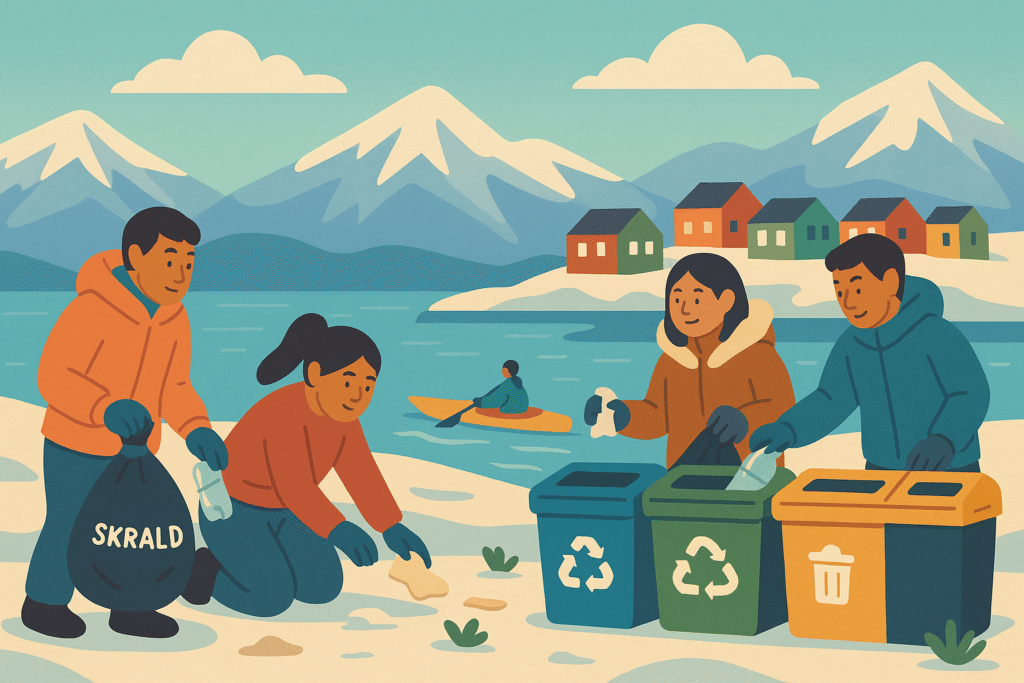
These lessons often extend beyond the classroom. Community clean-up events and practical workshops give young people the chance to see the results of their efforts first-hand, fostering both responsibility and teamwork. Such activities are helping to build a culture of environmental care that starts early and lasts a lifetime.
At a vocational level, Tech College Greenland has developed training modules to prepare skilled workers for the waste management sector. This professional path — supported through national education programmes — strengthens local capacity and reduces dependence on external expertise. It also ensures that sustainability is seen not only as an idea but as a practical, employable skill.
Community engagement and local pride
In many towns, young volunteers and community groups are taking part in clean-up campaigns and awareness days that highlight the importance of waste reduction. These events combine environmental action with cultural pride, reminding participants that Greenlandic traditions have long valued respect for nature and resourcefulness.
By linking environmental awareness with cultural identity, these initiatives inspire a sense of ownership. The message is simple but powerful: taking care of the land is part of taking care of each other.
A new generation of responsibility
Waste management in Greenland is still evolving, but the progress is clear. New technologies, local planning, and education are turning what was once a logistical challenge into a learning opportunity.
In classrooms, workshops, and communities, young people are discovering that sustainability begins with knowledge — and that even the smallest actions can contribute to a cleaner, stronger, and more self-reliant Arctic future.
Sources:
Arctic Today – Two new incinerators aim to ease Greenland’s trash problem (2022) — https://www.arctictoday.com/two-new-incinerators-aim-to-ease-greenlands-trash-problem/
Babcock & Wilcox – Energy-from-Waste Plants, Nuuk & Sisimiut, Greenland (2023) — https://www.babcock.com/assets/PDF-Downloads/Renewable-Downloads/PCH201-148-Nuuk-Sisimiut-WTE.pdf
Avannaata Municipality – Waste Management and Environment Strategy — https://plania.avannaata.gl/en/2020-planning-strategy/ten-strategic-focus-areas/9-waste-management-and-environment/
European Commission – Programming Document for the Sustainable Development of Greenland 2014–2020 (Education Programme) — https://international-partnerships.ec.europa.eu/system/files/2020-02/signed_programming_document_for_sustainable_development_of_greenland_2014-2020_colour.pdf
ResearchGate – Waste management in Greenland: Current situation and challenges (Eisted & Christensen, 2011) — https://www.researchgate.net/publication/50304022_Waste_management_in_Greenland_Current_situation_and_challenges