In a land where the growing season lasts only a few months and most products must travel thousands of kilometres, food is more than nourishment — it is resilience. Across Greenland, communities, entrepreneurs, and researchers are rethinking what local food means in the Arctic, combining traditional practices with new technologies to build a sustainable and self-reliant future.
From imported goods to local growth
For decades, Greenland has depended heavily on imported food, with cargo ships bringing most fresh produce from Denmark or Iceland. This dependency has environmental costs: high transport emissions, limited freshness, and little local control over supply.
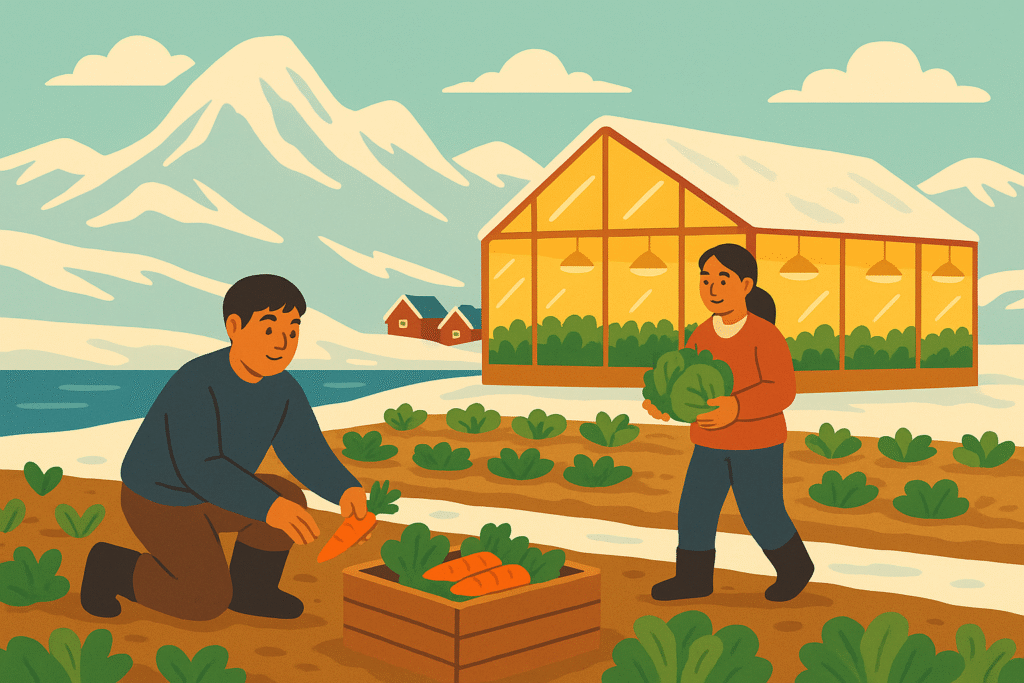
In recent years, however, several initiatives have emerged to strengthen Greenland’s local food systems. Greenhouses, hydroponic farms, and small-scale production facilities are being established to grow vegetables and herbs year-round — even during the long Arctic winter. The goal is simple but transformative: reduce imports, lower emissions, and provide communities with fresh, healthy, locally produced food.
Arctic farming in practice
One of the most successful examples is the Sermersooq Greenhouse Project in Nuuk, which supplies local restaurants and schools with fresh lettuce, herbs, and tomatoes throughout the year. Using advanced LED lighting, temperature control, and water recycling, the facility demonstrates that sustainable food production is possible even in extreme conditions.
Other municipalities are following suit. In South Greenland, small farms are expanding vegetable cultivation, supported by research from the Greenland Institute of Natural Resources and Nordic innovation funds. Local farmers experiment with soil management and protective greenhouses to extend the growing season, while community initiatives teach residents how to grow herbs and microgreens at home.
These projects are not only about technology — they are about food culture, pride, and independence. Producing locally strengthens communities, creates jobs, and connects people more closely to the land they inhabit.
Traditional knowledge meets innovation
Sustainability in Greenlandic food systems also draws on ancestral knowledge. Hunting, fishing, and gathering remain central to local diets, providing nutritious food with minimal carbon footprint. Many initiatives aim to combine these traditions with modern standards of safety and quality, ensuring that local products can be marketed sustainably both within Greenland and abroad.
Restaurants and chefs in Nuuk and Ilulissat are now redefining Greenlandic cuisine around local ingredients such as reindeer, musk ox, Arctic herbs, and seafood. The movement, often called New Arctic Cuisine, promotes local sourcing, zero waste, and storytelling through food. By doing so, it links environmental awareness with cultural renewal — a powerful recipe for sustainability.
Circular thinking for Arctic communities
Food sustainability in Greenland is not only about what people eat, but how they manage resources. Many greenhouse projects reuse excess heat from nearby buildings, while organic waste is composted to improve soil fertility. These practices embody circular economy principles — using what’s available, minimising waste, and closing the loop between production and consumption.
The lessons go beyond Greenland: in a changing climate, the Arctic is teaching the world how local innovation, traditional wisdom, and community cooperation can create resilient food systems even in the most challenging environments.
Seeds of resilience
Every greenhouse built, every meal cooked with local ingredients, and every class teaching children about food and sustainability is part of a larger transformation. Greenland’s approach to local food is about more than self-sufficiency — it’s about respect for nature, culture, and the next generation.
The future of Arctic food is already growing — one seed, one community, and one shared meal at a time.
Sources:
Visit Greenland (Traveltrade) — Local food sources & vegetables grown in Greenland https://traveltrade.visitgreenland.com/latest-news/local-food-sources-and-vegetables-grown-in-greenland-a-sustainable-story-of-greenlandic-food-culture/ Traveltrade – Visit Greenland
Arctic Hub — Education and research pave the way for a more self-sufficient Greenland https://arctichub.gl/education-and-research-pave-the-way-for-a-self-sufficient-greenland/ arctichub.gl
Nordic Council of Ministers — Towards healthy and sustainable diets in Greenland and the Faroe Islands (policy brief, 2025): https://pub.norden.org/nord2025-005/nord2025-005.pdf pub.norden.org
Nordic Council of Ministers — Greenlandic Greenhouse (nominee profile): https://www.norden.org/en/nominee/greenlandic-greenhouse-greenland norden.org
Greenland Institute of Natural Resources — Synthesis report on agriculture in Greenland (PDF): https://natur.gl/wp-content/uploads/2020/03/ENG-Synthesis-Report-on-Agriculture-in-GL.pdf natur.gl