Artificial turf is popular as it allows indoor and outdoor sports year-round, endures heavy use and variable weather, and avoids the need for sunlight, water or fertilizers that natural grass demands.
However, when artificial turf reaches end-of-life (typically after 8-12 years), disposal becomes a serious environmental problem. Conventional approaches like incineration emit roughly 400 tonnes of CO₂ per pitch, and landfilling poses risks of chemical leaching and microplastics entering groundwater. In 2020 alone, about 14,000 artificial-turf pitches were either incinerated or sent to landfill; the plastic content alone equates to roughly 19.5 billion plastic bags. Forecasts suggest 52,000 pitches will need replacement by 2030.
The solution
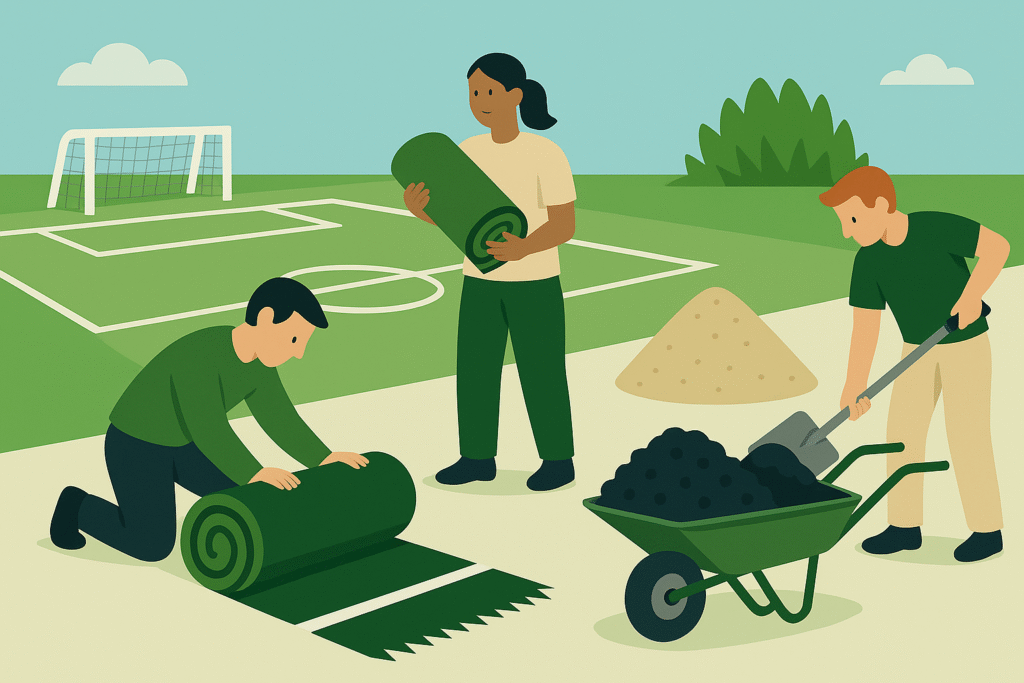
Danish company Re-Match has developed a fully traceable mechanical recycling process (with no water or harmful chemicals) that separates worn-out artificial turf back into its original materials: plastic fibres, sand, rubber and backing.
Here’s how the process works:
- The turf pitch is analysed and assigned a unique batch number for full traceability.
- It is transported to one of Re-Match’s recycling plants (in Denmark and soon in the Netherlands & France).
- The turf is shredded, sifted, cleaned and separated into the constituent raw materials.
- Separated materials are reused
The result
Re-Match’s approach enables full circularity of end-of-life artificial turf. It is certified by the European Commission’s ETV (Environmental Technology Verification) for third-party validation of its claims.
Their operations have achieved: by 30 September 2021, they had recycled 662 pitches (across several Northern European countries) whitch equivalent to removing 10,000 lorries of waste, 116,000 tonnes of waste, 520 million plastic bags worth of material, and substantial CO₂ savings.
Each recycled pitch yields a CO₂ saving of approximately 400 tonnes compared to incineration (equal to ~1.4 million plastic bags), while the recycling process itself emits less than 20 tonnes of CO₂ per pitch.
There are cost-benefits too: disposing of worn-out pitches via this method is about 10% cheaper than incineration/landfill; and purchasing the recycled raw materials costs up to 80% less than buying virgin materials.
Why it matters
- Encourages sustainable practices in sports infrastructure where artificial turf is increasingly used.
- Reduces pressure on landfills and incineration, mitigates microplastics and chemical-leaching risk, and cuts greenhouse-gas emissions.
- Promotes circular economy thinking: waste (old turf) becomes feedstock for new products.
- Offers sports clubs, municipalities and installers a more responsible and cost-effective disposal option.
With the expected surge in artificial-turf pitches needing replacement (52,000 by 2030), scalable solutions like this are critical. The model shows how sports surfaces can move from a linear “take-make-dispose” system into a closed-loop system where materials are reused, not wasted.
Source:
State of green (2022). Sustainable sport services: https://stateofgreen.com/en/solutions/sustainable-sports-surfaces/