
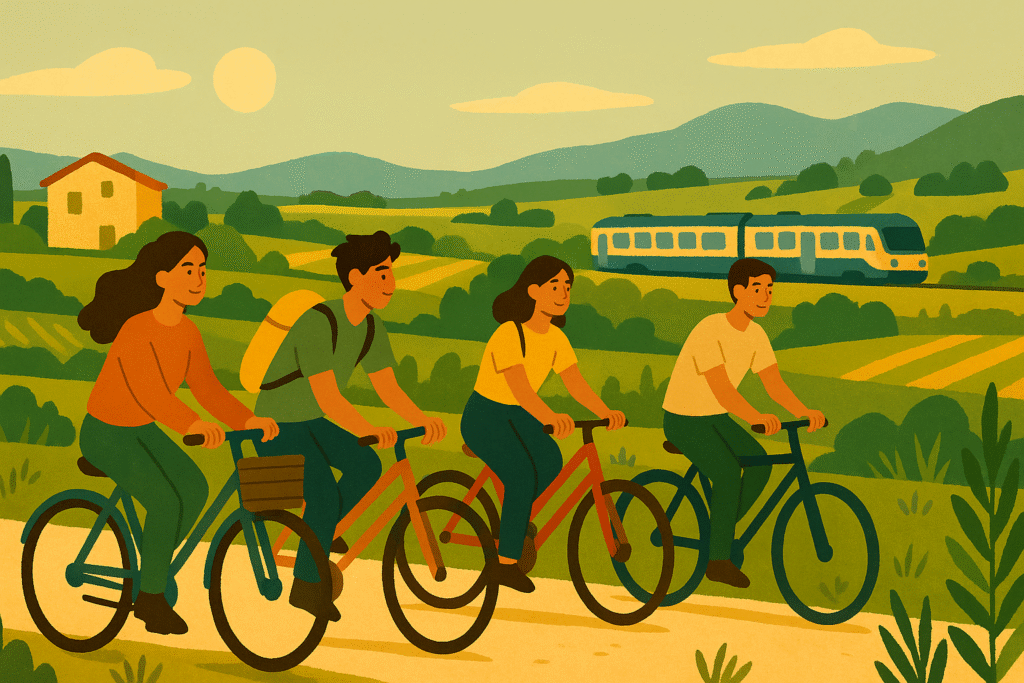
A different way of travelling is taking hold across Spain. Young people are choosing trains and bicycles over flights and cars, staying with community initiatives, and asking for proof that their money supports local nature and livelihoods. The shift is practical rather than glamorous. It is about routes that already exist, hostels that publish their impact and destinations that certify genuine ecotourism.
Low-carbon journeys that connect places
Spain’s Greenways programme (Vías Verdes) turns disused rail lines into safe cycling and walking routes that link villages, stations and natural areas. More than 3,500 kilometres of tracks have been converted, which means young travellers can plan multi-day trips on gentle gradients, carry their own kit and spend in small businesses along the way. The routes are mapped and maintained by the Fundación de los Ferrocarriles Españoles, making slow travel a real option rather than a slogan.
For longer itineraries, EuroVelo offers three signed cycling routes across Spain, including the Mediterranean and Atlantic corridors. Student groups often combine a EuroVelo section with local Greenways to create low-carbon trips that end at a village hostel or nature reserve rather than a crowded hotspot. The routes are coordinated nationally with cycling organisations and provide practical planning information for stages, services and connections.
Staying where value stays
To avoid green marketing and focus on real benefit, many travellers look for destinations in the Eco-turism Club in Spain. The national association groups protected areas, local guides and accommodation providers that meet environmental and social criteria and commit to conservation and community welfare. The consumer-facing platform Soy Ecoturista (I am eco-tourist) makes these offers visible and explains how bookings support local jobs and biodiversity management. This is not just a label. It is a product club with rules, audits and a clear link between nature protection and livelihoods.
Hostels that measure social impact
In Barcelona’s Collserola Natural Park, INOUT Hostel shows what inclusive and sustainable hospitality looks like. Run by a non-profit entity, it is a Special Employment Centre where the vast majority of staff are people with disabilities. The hostel publishes its social mission, highlights accessible facilities and has been profiled by sector platforms for its employment model and environmental practices. For young travellers, staying here turns a night’s rest into support for decent work and inclusion, which is part of any honest definition of sustainable tourism.
Travel as a local contract
Projects that bring visitors to villages on longer stays are also growing. Rural coliving models such as Rooral invite small cohorts of remote workers to live and spend in host communities, combining low-impact mobility with cultural preservation and local suppliers. These stays are planned with municipalities and residents, which helps align visitor behaviour with village priorities. The approach is not about consumption. It is about time, learning and mutual benefit.
Green tourism in Spain is becoming a set of choices that anyone can make. Take the train and a bike-friendly route. Book with a certified ecotourism destination. Choose hostels and projects that publish their social and environmental impact. Ask for evidence when a claim sounds vague. Each decision keeps value closer to the place that hosts you and turns travel into support for climate and community goals.
Sources:
Greenways – Spanish Greenways Programme and routes. viasverdes.com
EuroVelo Spain – National and route information for EV1, EV3 and EV8. en.eurovelo.com
Club Eco-turism – Product club and certified offers. soyecoturista.com
INOUT Hostel – Social enterprise hostel with accessibility and inclusion focus. https://www.inouthostel.com/en
Rooral – Rural coliving and community-centred stays. https://www.rooral.co/