Classrooms in Spain are becoming laboratories for climate action. Students and teachers are turning sustainability into a daily practice through gardens, repair projects and energy awareness. The movement is not limited to one city. It connects national and municipal programmes with hands-on work that young people can see and lead.
National and city frameworks that make change practical
Spain’s Eco-Schools network, coordinated by ADEAC, supports hundreds of schools that follow a clear, participatory method. Centres form an eco-committee, complete an audit, plan actions and monitor progress. Schools that meet the criteria receive the Green Flag recognition. The focus is long-term improvement rather than one-off activities.
In Barcelona, Escoles + Sostenibles (“Sustainable Schools”) gives education centres tailored guidance, training and materials so they can integrate sustainability across the curriculum and school spaces. The programme is also featured on Spain’s national environment portal, which helps other municipalities learn from the model.
School gardens that teach resilience
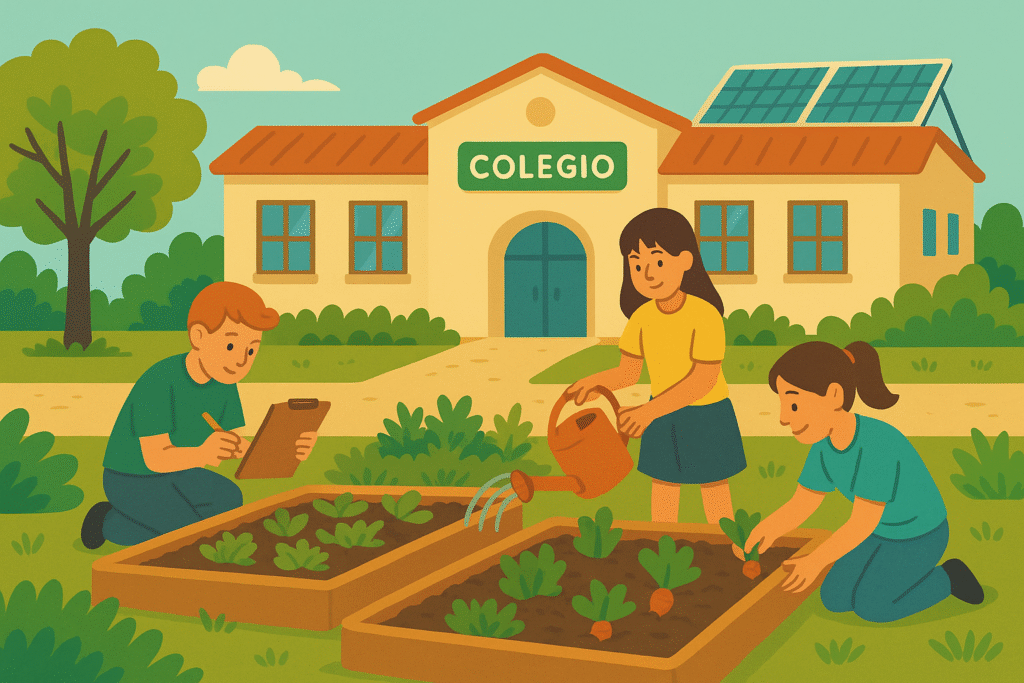
School gardens are one of the clearest bridges between learning and climate skills. In Madrid, the Network of Sustainable School Gardens supports centres with training, materials and a peer network that shares methods, from composting to water-wise cultivation. The public site explains how gardens link to the curriculum and how teachers get technical support to keep projects running through the year.
Valencia’s municipal education service runs a citywide School Gardens Network with dedicated teaching programmes. Resources show how schools use the garden as an outdoor classroom and how the network supports teachers with modules that build continuity beyond a single term.
Student leadership in action
Student eco-committees take practical decisions that students can track and explain to peers. In many Eco-schools centres, pupils measure waste by type, redesign classroom routines to reduce energy use and present findings to families during open days. Barcelona’s Escoles + Sostenibles shares school project sheets that show how pupils lead audits, set targets and follow up on results.In Seville, the city’s Urban Gardens Facilitation Programme involves dozens of schools and civic centres and uses gardens as a learning space for ecology, food and health, which gives students regular, visible roles in care and monitoring. Bilbao’s School 2030 Agenda frames student participation across subjects so climate literacy connects with local action
What sets credible school action apart
These initiatives share three features that cut through greenwashing. First, they are structured and transparent. Eco-schools requires audits, action plans and monitoring, and city programmes publish objectives and joining procedures. This allows students to measure change and present results to their community.
Second, they are curriculum-linked. Madrid’s garden network and Valencia’s programmes place the garden in science, arts and language classes, which turns sustainability into a cross-subject habit rather than an optional club.
Third, they are hands-on and student-led. Eco-committees, repair days and garden tasks give young people visible roles. When students design the compost system, track water use or present a plan to reduce waste, they learn how to interrogate claims and ask for evidence, which is the basis of climate literacy.
From lessons to lifelong skills
Schools in Spain are showing that climate education is most effective when it changes how a centre works day to day. A garden harvest that feeds a school kitchen, a class that maps energy use, or a committee that rewrites canteen rules all create feedback that students can see. These routines build confidence and invite families to join. They also prepare young people to evaluate environmental claims outside school and to lead in their neighbourhoods.
Sources:
Ecoescuelas (Eco-Schools Spain), ADEAC: https://www.ecoescuelas.org/
Escoles + Sostenibles (“Sustainable Schools”), Barcelona: https://www.barcelona.cat/barcelonasostenible/es/centros-educativos/quienes-somos/el-programa-escuelas-sostenibles
Network of Sustainable School Gardens in Madrid: https://www.madrid.es/portales/munimadrid/es/Inicio/Medio-ambiente/Educacion-Ambiental/Red-de-huertos-escolares-sostenibles/
School Gardens Network in Valencia: https://educacio-valencia.es/es/proyectos/red-de-huertos-escolares-de-la-ciudad-de-valencia/
Urban Gardens Facilitation Programme in Sevilla: https://www.huertosurbanossevilla.es/
Bilbao’s School 2030 Agenda: https://www.bilbao.eus/cs/Satellite?c=BIO_Servicio_FA&cid=3007532621&language=es&pagename=Bilbaonet%2FBIO_Servicio_FA%2FBIO_Servicio Bilbao