As Europe strives for climate neutrality, ambitious offshore wind and grid-infrastructure goals are pushing the boundaries of energy innovation. Denmark has set a target of reducing greenhouse gas emissions by 70 % by 2030 (relative to 1990 levels) and meeting all its electricity demand with renewables. Simultaneously, the EU plans to install at least 60 GW of offshore wind capacity by 2030 and up to 300 GW by 2050.
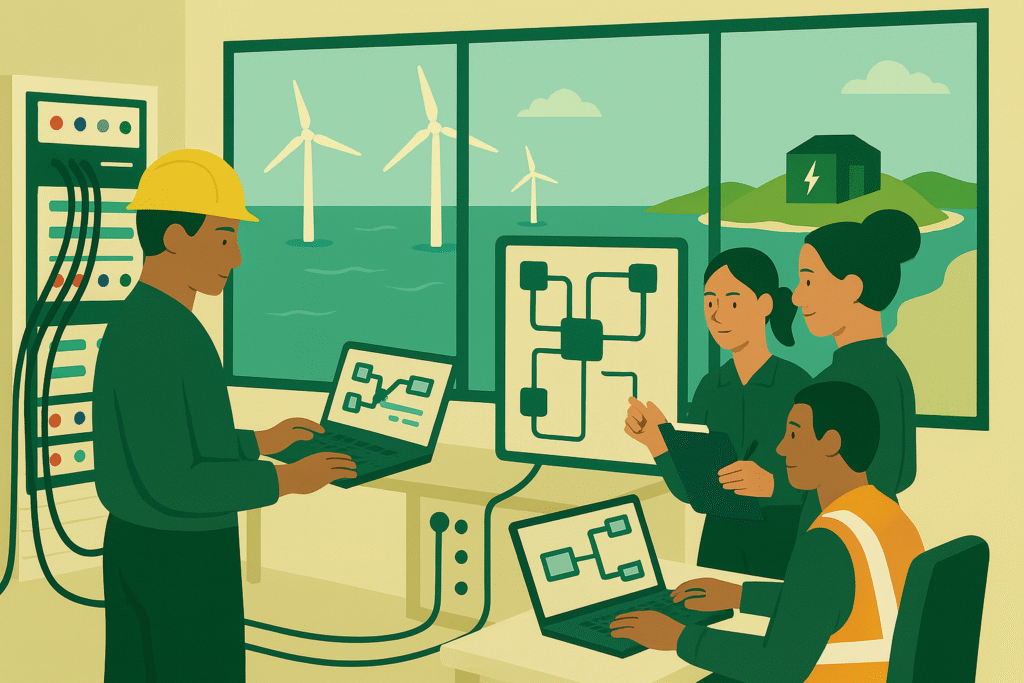
To meet these objectives, Denmark has committed to establishing two major “energy islands”. One will be an artificial island or platform in the North Sea and the other a hub in the Baltic Sea on the island of Bornholm. The Baltic-Sea hub will initially collect power from offshore wind farms with a capacity of 2 GW, with potential expansion to 3 GW or more in future.
Bornholm offers several strategic advantages: its existing “Bright Green Island” strategy aims for carbon-neutral energy production, robust infrastructure links, and prior experience as a living-lab for green technologies. The project envisions the creation of a power hub that will convert and route electricity via high-voltage direct current (HVDC) cables to both the Danish and German grids, enabling cross-border power flows and enhanced system flexibility.
When operational by 2030, the energy islands are expected to deliver some 5 GW of green electricity which isequivalent to the average power consumption of around five million households, while potential expansions could generate up to 12 GW. Beyond electricity, the hub is designed to support “Power-to-X” applications: converting green power into hydrogen and synthetic fuels to decarbonise hard-to-abate sectors such as shipping, aviation and heavy industry.
In addition to environmental benefits, the infrastructure project is a major economic driver. Construction of the Bornholm hub alone is estimated to create hundreds of jobs (for example, some 400 during the build phase and around 100 for operations) and stimulate local and regional growth.
In short, the Bornholm Energy Island represents a paradigm shift: from isolated offshore wind farms to integrated, multinational energy hubs that link generation, transmission and conversion at scale. It demonstrates how cooperation, innovative infrastructure and strategic geography can enable the transition to a resilient, interconnected, and zero-carbon European energy system.
Source:
State of green (2022). Energy island – the Baltic Sea’s nodal point for intelligent energy: https://stateofgreen.com/en/solutions/energy-island-the-baltic-seas-nodal-point-for-intelligent-energy/
Energistirelsen (2024) Bornholm energy island: https://ens.dk/en/energy-sources/bornholm-energy-island?utm_source