In many Spanish cities, a quiet shift is underway. Young people, families and teachers are reclaiming the streets around schools so children can breathe cleaner air, cycle together and arrive safely. The movement is practical and visible. It closes roads at drop-off times, paints new play zones, plants shade, and measures what changes. Street by street, daily mobility becomes climate action.
From protest to practice
What started as Friday demonstrations has grown into a nationwide call for safer school streets. Under the banner Revuelta Escolar (School Revolt), families and pupils have rallied in dozens of cities to demand car-free entrances, slower traffic and cleaner air. Their message is simple. Children deserve space and safety outside their schools, and the city should adapt to them. The campaign now links with the European Streets for Kids days of action, which in May 2025 mobilised more than eighty events across Spain. The format is inclusive, from chalk games to citizen petitions, and it anchors climate goals in everyday life.
School streets that change air and behaviour
Barcelona’s Protegim les Escoles (Let’s protect schoohls) programme shows what transformation looks like when a city commits. Streets by schools are calmed with new pavements, urban furniture and trees, and parking is removed at the gates. Independent evaluations track how traffic, noise and air quality respond, so decisions rest on evidence rather than slogans. By 2023, interventions had reached hundreds of school fronts, and the model is being studied for impact on public space use and environmental quality. The idea is simple. If you change the street, you change the journey.
Citizen science that turns concern into data
In Barcelona, the xAire project invited school communities to place passive sensors and map NO2 (nitrogen dioxide) with unprecedented resolution. Families and pupils identified hotspots, collected samples and presented results to the city. The method is replicable. A class learns how to choose locations, handle tubes, validate data and communicate findings with care. It is climate literacy in action, and it equips young people to ask better questions of local authorities.
Cycling together, safely
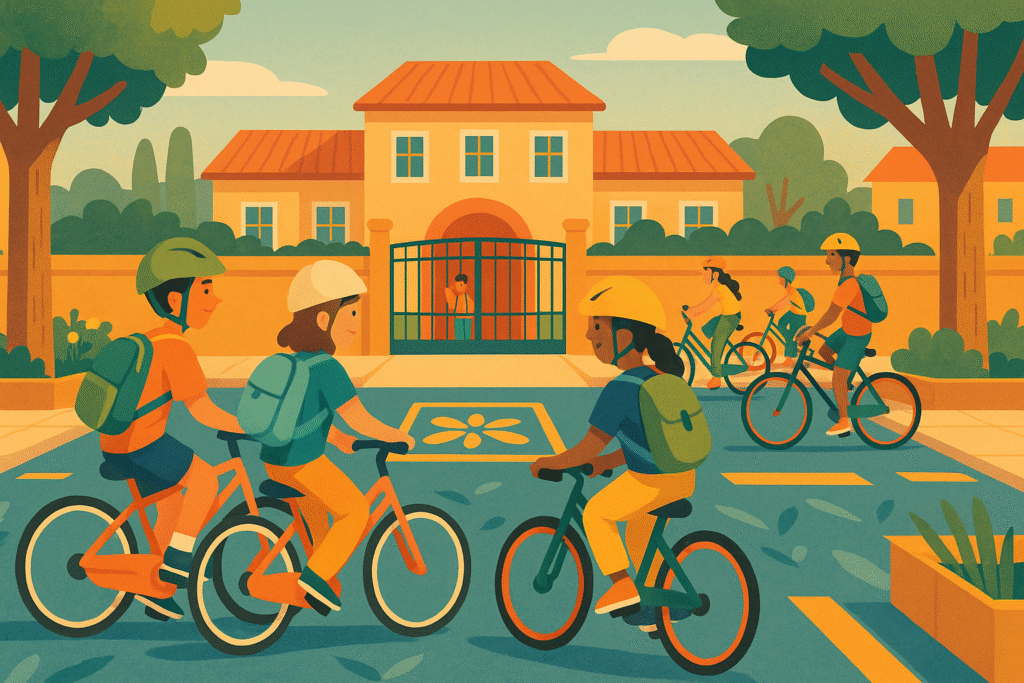
Another youth-led practice spreading across Spain is the bicibús or bike bus. Groups of children cycle to school along fixed “lines” with volunteer marshals, stopping at designated corners to pick up more riders. In Barcelona, the network reports thousands of journeys each year and has inspired similar routes in other cities. The effect is cultural as well as practical. Confidence grows, parents leave the car at home, and streets feel shared again.
Policy that meets the street
Large cities are also expanding LEZs (Low Emission Zones) to cut pollution from the most polluting vehicles. In Madrid, the Madrid 360 framework structures the city’s low-emissions areas and complements school-street measures. Youth groups and parent associations use these policies as a lever for local change, asking for speed control, timed filters at school gates and safer cycling links. When activism, measurement and policy align, the school run turns into a daily lesson in public health and climate action.
Young people are showing that mobility transitions do not start with technology, they start with streets designed for care. Close the lane, add a crossing, plant a tree, run a bike bus, measure the air, and share the results. Step by step, cities become places where arriving at school is safe, social and low carbon.
Sources
Revuelta Escolar — Movement for calm, safe school streets and national spread: https://www.revueltaescolar.com/
Barcelona City Council — Protect Schools programme overview: https://ajuntament.barcelona.cat/ecologiaurbana/en/what-we-do-and-why/urban-planning-for-neighbourhoods/protect-schools
ISGlobal — xAire citizen science launch and context: https://www.isglobal.org/en/-/la-comunidad-educativa-de-barcelona-desplegara-mas-de-800-sensores-para-medir-la-calidad-de-su-aire
Science of the Total Environment — xAire large-scale citizen science study on NO2: https://www.sciencedirect.com/science/article/pii/S0048969721028217
Bicibús — What a bike bus is and how it works: https://bicibus.eu/en/
The Guardian — Report on Barcelona’s bicibús growth and uptake: https://www.theguardian.com/lifeandstyle/2023/oct/04/bicibus-how-barcelona-got-kids-cycling-safely-to-school
Madrid 360 — Low-Emissions Zone framework (overview report): https://reports.weforum.org/docs/WEF_Madrid_360_low_emissions_zone_2025.pdf