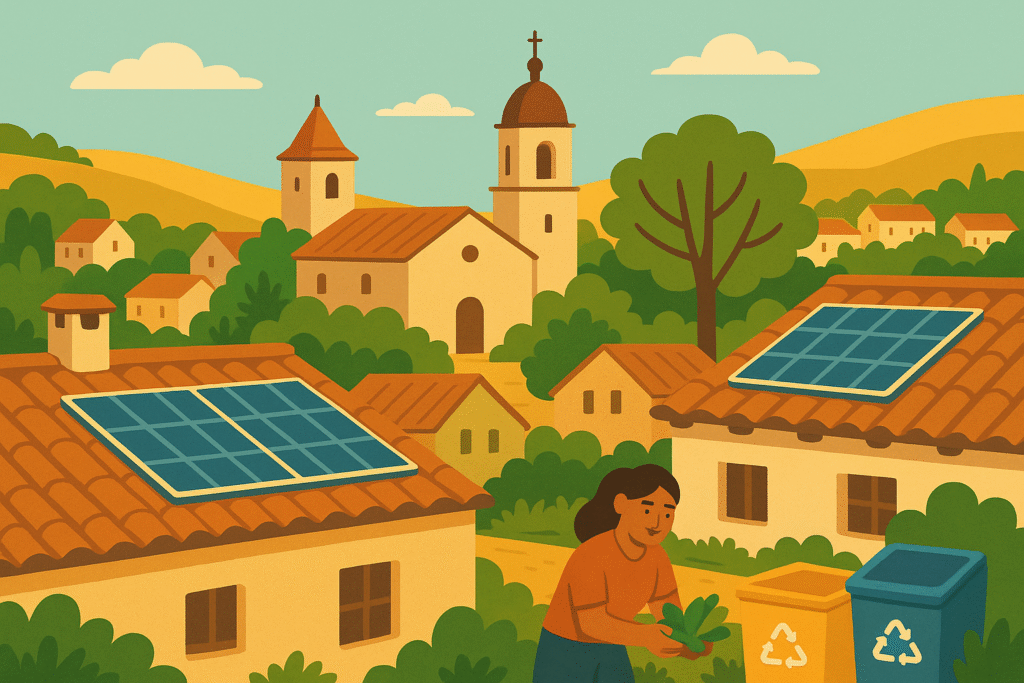
Across rural Spain, towns are taking energy into their own hands. Young people, neighbours and local councils are forming energy communities that generate and share solar power, keep benefits local and turn the energy transition into everyday participation.
The power of community ownership
In the small Almería village of Almócita, residents set up a local photovoltaic energy community so households and public buildings could share clean electricity. The project documents explain how the municipality involved neighbours, where panels were installed and how the shared model works. This clarity helps other towns learn and adapt the approach.
A technical case study of Almócita’s installation shows how the system was designed and how the village aimed for collective self-consumption. These details matter because they turn a headline about solar into a replicable method.
Heritage towns joining the transition
Historic centres often face extra barriers because visible roof panels can be restricted. Toledo’s old town created what the city calls the first community energy scheme in a Spanish World Heritage historic centre. The model uses municipal roofs within two kilometres of the protected area so residents and small organisations inside the walls can subscribe and receive shared solar power. A second phase is already planned due to demand.
City press notes add context about the programme’s expansion and how the council is preparing new public roofs for solar generation, which signals stable support for the community model.
Youth at the heart of local energy
Spain’s cooperative movement gives young people practical roles in the transition. Som Energia, founded by graduates and teachers in Catalonia, is now one of the country’s best known renewable cooperatives. It supplies members with certified renewable electricity and finances new generation with citizen investment. Profiles from European cooperative networks describe its growth and how members collectively fund solar. That pathway has helped seed local groups and youth participation far beyond Catalonia.
What makes these communities credible
Community energy counters generic “green” marketing because the rules, ownership and benefits are clear. Spain’s energy agency IDAE provides guidance and funding routes for community projects, setting out how to constitute a local energy community and where pilot finance can come from. These national resources help small municipalities and cooperatives navigate legal steps and avoid vague claims.
Projects like Almócita publish partners and technical choices. Toledo’s scheme explains how a heritage city solved proximity constraints by using municipal roofs nearby. Cooperatives disclose governance and membership. These simple practices build trust and allow others to check the facts.
Why this matters for rural youth
For many young people, community energy is a way to stay and work in their regions. It blends engineering, communication and cooperative management. Some return after studying to help set up or run local schemes, deliver school workshops or guide new members through the sign-up process. Others get involved through internships with cooperatives or town halls, and then launch small businesses that service local installations. The result is a transition that is not only cleaner but also rooted in local skills and responsibility.
From panels to participation
Energy communities in Spain are growing because they combine technology with everyday democracy. Members vote, budgets are public and savings are reinvested locally, whether in more panels or support for energy-vulnerable households. This is how the transition becomes visible in village life. It is also how communities guard against greenwashing. When neighbours can see the panels, read the statutes and check the meters, claims are not just words. They are shared results.
Sources:
Municipality note on Almócita’s community energy set-up: https://www.almocita.es/Servicios/cmsdipro/index.nsf/noticias.xsp?documentId=9AF1A05AA297F458C12586CB002086EE&p=Almocita almocita.es
Almócita project page with technical overview: https://albedosolar.com/project/comunidad-energetica-almocita/ albedosolar.com
Case study on Almócita’s collective self-consumption: https://www.fronius.com/es/~/downloads/Solar%20Energy/References/SE_REF_Community_Selfconsumption_Almocita_ES.pdf fronius.com
Toledo historic centre community energy, background report: https://elpais.com/espana/2025-07-02/toledo-crea-la-primera-comunidad-energetica-en-un-casco-historico
Toledo City updates on expansion and second phase: https://www.toledo.es/velazquez-pide-la-ampliacion-del-proyecto-de-la-otc
Som Energia cooperative overview and network profile: https://www.rescoopvpp.eu/spain
IDAE guidance and funding information for community energy: https://www.idae.es/ayudas-y-financiacion/comunidades-energeticas