Across Spain, young people are rediscovering the power of soil. Not through industrial farming, but through regenerative agriculture and urban gardens that heal land, community, and culture. From the historic L’Horta de València (the fertile agricultural plain surrounding Valencia) to new agroecological projects across the country, a quiet revolution is reshaping how food is grown and how sustainability is understood.
The Horta that feeds the city
L’Horta de València is more than a landscape — it is a living system of canals, orchards, and farms that has sustained the city for centuries. After years of decline caused by urban expansion and industrial agriculture, a new generation of farmers in their twenties and thirties is bringing it back to life.
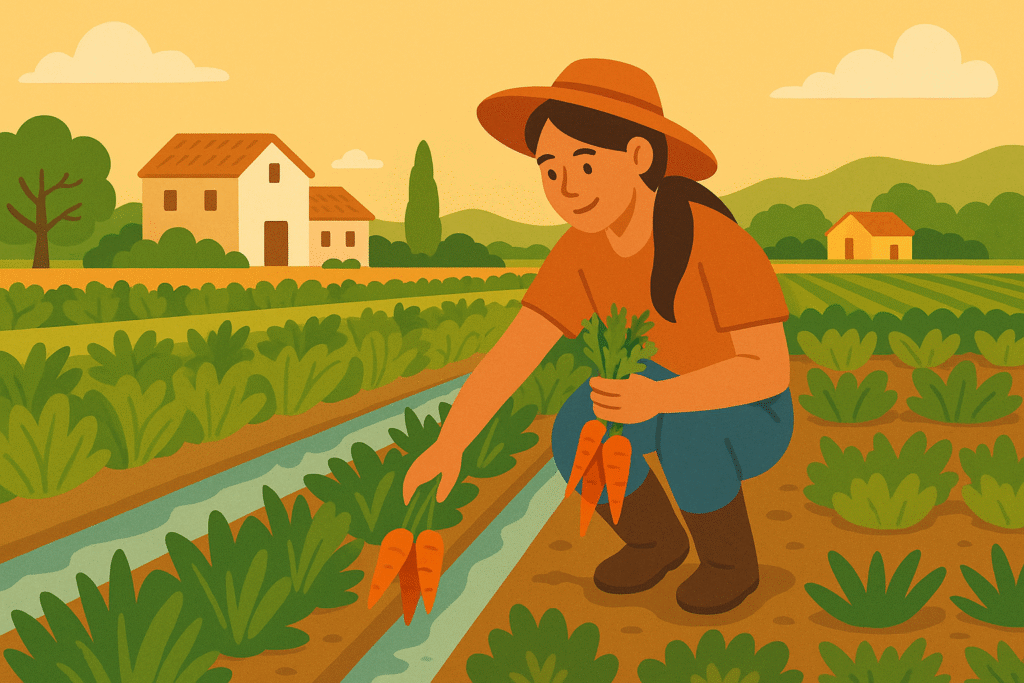
With support from local institutions and cooperatives, these young farmers are reclaiming abandoned plots, cultivating vegetables and herbs using organic methods, and supplying local markets and restaurants. Their work goes beyond food production: they restore biodiversity, strengthen local identity, and prove that agriculture can coexist with urban life.
Valencia’s Urban Agriculture Plan (Plan de Agriculturas Urbanas) and the Agrarian Development Plan of the Horta (Plan de Desarrollo Agrario de l’Horta) support this revival by integrating farming spaces into the city’s green infrastructure and promoting education, community gardens, and youth participation. In neighborhoods and schools, urban gardens now serve as learning spaces for sustainability, reconnecting people with the soil beneath their feet.
The result is a new social movement — one that sees agriculture not only as an economic sector, but as culture, education, and climate action.
Regenerative agriculture beyond the city
Regenerative agriculture goes further than “organic.” It focuses on rebuilding soil health, restoring biodiversity, and capturing carbon naturally. In rural Spain, the La Junquera Regenerative Farm in the Altiplano region of Murcia is a leading example.
The project has trained hundreds of young farmers and professionals, restored over 2,500 hectares of degraded land, and increased soil organic matter from 2 % to 6 %. By combining crop diversification, composting, and water retention systems, La Junquera demonstrates how environmental regeneration can coexist with viable rural livelihoods.
Similar initiatives across Spain — from cooperatives to social enterprises — are transforming conventional agriculture into circular, low-impact systems that regenerate rather than deplete. They show that farming can be part of the climate solution, not the problem.
Four principles defining a new generation of farming
- Soil health as foundation – Compost, cover crops, and reduced tillage improve fertility and capture carbon.
- Diversity over monoculture – Crop rotation and intercropping create resilience and reduce chemical dependency.
- Water efficiency and retention – Healthy soils absorb and store water, reducing floods and drought impacts.
- Youth training and leadership – Education and entrepreneurship empower young people to drive this transformation.
These principles distinguish genuine sustainability from greenwashing. Regeneration takes time, care, and transparency — values that can’t be simulated by marketing campaigns.
Why young people matter
For Spain’s youth, farming is becoming a field of activism. It connects climate action, employment, and social innovation. Cooperatives such as L’Horta Viva show that it’s possible to make a living while restoring ecosystems and preserving cultural heritage.
Urban farmers in cities like Valencia, Madrid, and Barcelona transform vacant land into shared learning spaces, cultivating both food and social inclusion. Through their hands, regenerative agriculture becomes a form of climate education — and a practical antidote to greenwashing.
Sowing the future
From urban gardens to rural regeneration, Spain’s young farmers are proving that the path to sustainability begins with the soil. Their work feeds people, revitalises communities, and reminds us that the most authentic form of climate action may be the simplest one: growing life where it had been forgotten.
Sources:
Valencia City Council – Urban Agriculture Plan (Plan de Agriculturas Urbanas de València) — https://jardins.valencia.es/es/contenido/plan-agriculturas-urbanas-valencia
Council of the Horta – Agrarian Development Plan (Plan de Desarrollo Agrario de l’Horta de València) — https://consellhorta.gva.es/es/pda-horta
Agricultural eco-commerce – The Valencian Community looks to young people to secure its agricultural future — https://ecomercioagrario.com/la-comunitat-valenciana-mira-a-los-jovenes-para-asegurar-su-futuro-agricola/
EU CAP Network – La Junquera: Regenerative Agriculture and Rural Development Initiative — https://eu-cap-network.ec.europa.eu/good-practice/la-junquera-regenerative-agriculture-and-rural-development-initiative_en Ficosterra – Regenerative agriculture: the solution to soil erosion — https://www.ficosterra.com/en/regenerative-agriculture-the-solution-to-soil-erosion/