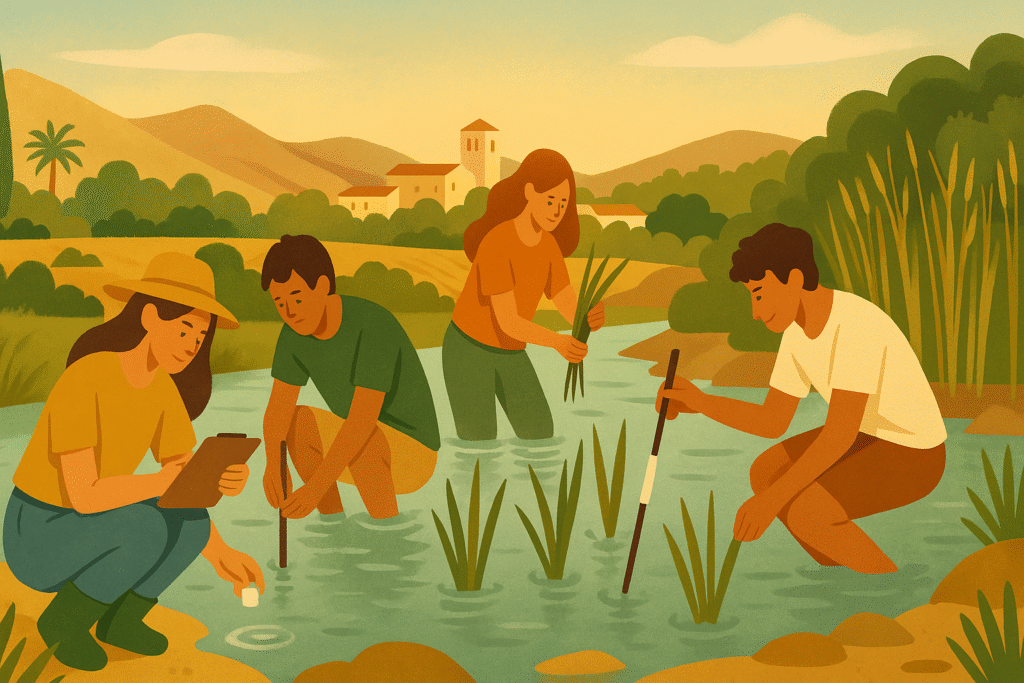
In the sun-baked southeast of Spain, where water shapes the rhythm of life, young people are learning to care for rivers and wetlands as if they were living archives. In Murcia and Almería, volunteer brigades, student groups and local NGOs are restoring riparian forests, reviving saltworks and turning citizen science into everyday practice. The work is patient and visible: plant native reeds, repair an old sluice, weigh the rubbish taken from a dry channel, count the birds that return. It is adaptation written into the landscape.
From river margins to resilient corridors
Along the Segura basin, youth volunteers join ANSE (Naturalists’ Association of the South-East of Spain) to stabilise eroded banks, replant native species and record changes in habitat. Under projects such as Naturaqua2000, teams combine hands-on restoration with data collection, building riparian corridors that can better withstand heat and flood. The emphasis is on method as well as outcome, so participants learn how to monitor vegetation and fauna and how to report results that inform future work.
Wetlands that teach by doing
Where water lingers, learning follows. At Lagunas de Campotéjar in Molina de Segura, municipal programmes invite volunteers and students to join bird-ringing sessions and field monitoring. The sessions start early, rely on careful handling and end with shared spreadsheets that feed into local management. For many young participants, it is a first encounter with applied ecology, evidence and long-term stewardship rather than one-off activities.
Salt, heritage and community care
In Cartagena’s Salinas de Marchamalo, restoration links ecology with cultural heritage. ANSE has rebuilt historic saltworks infrastructure, improved habitat for waders and reopened guided visits and training, showing how small-scale salt production can sit alongside conservation. In 2025, the project received a Hispania Nostra award for good practice in natural and cultural heritage, a recognition grounded in open documentation and collaboration with neighbours and public bodies.
The Almería coast, repaired by many hands
On the Cabo de Gata-Níjar shoreline, volunteer calls have mobilised dozens of groups at Rambla Morales, a fragile coastal lagoon. Over successive clean-ups, people removed glass and mixed waste by hand and organised access to minimise disturbance, an approach that shows how community logistics can protect sensitive habitats. The message to participants is practical and hopeful, small interventions change what a season looks like for a wetland.
Water culture, shared responsibility
Stewardship here is also cultural. Campaigns around the Menor Sea connect farming practices, water quality and wetland recovery, while youth routes and coastal walks invite teenagers to read the shoreline for signs of stress and repair. The lesson is consistent, care begins with understanding how water moves through a place and who depends on it.
Young people are making adaptation tangible. Riparian plantings hold soil after autumn storms, bird counts rise where disturbance drops and clean-ups leave a wetland looking like a wetland again. Perhaps most importantly, participants carry methods home, how to plan a survey, what to record, where to report. The southeast’s water reality will remain demanding, yet a generation that can monitor, restore and advocate gives the region options that go beyond emergency.
Sources
ANSE – Naturaqua2000 riparian restoration in the Segura basin. asociacionanse.org
Molina de Segura City Council – Volunteer bird-ringing at Lagunas de Campotéjar. medioambiente.molinadesegura.es
Hispania Nostra: Award and project details for Salinas de Marchamalo. premios.hispanianostra.org
Cabo de Gata community reports – Volunteer clean-ups at Rambla Morales.https://cabodegata.net/06-limpiar-rambla-morales-eco-no16/
SEO/BirdLife – SOS Mar Menor actions and citizen participation, plus regional clean-up campaigns. SEO/BirdLife